

A residue of powdered food flavourings is a recurring feature in the production of flavourings and ingredients for the food industry: it is generated during the drying stages and during equipment cleaning.
For a company in the Bergamo area (Italy) producing flavourings and ingredients for the food sector, the roughly 65 tons of powdered flavourings generated each year were managed as waste under EWC code 02 03 04 and sent for composting, at a disposal cost of €275 per ton.
Thanks to the industrial symbiosis partnership with Sfridoo, the powdered flavourings have been reclassified as a by-product under Article 184-bis of Italian Legislative Decree 152/2006 and destined for the production of organic fertilizers: this change in regulatory classification has transformed a disposal cost into a revenue of €25 per ton (Sfridoo Case Study CS41).
| CS41 Sfridoo | Before | After | Notes and operational Details |
|---|---|---|---|
| Case Study Overview | |||
| Industry | Region | Notes | |
| Original waste produce | Manufacture of other food products n.e.c. | Bergamo (Italy) | |
| Downstream use (user) | Manufacture of fertilisers and nitrogen compounds | Verona (Italy) | |
| Before and after comparison | |||
| Assessment for classification | Waste | By-product | Preparation of technical report, by-product data sheet, supply agreement, declaration of conformity, management plan. |
| Material fate | Composting | Organic fertilizers | |
| Quantity | ~65 tons per year | ~65 tons per year | |
| Storage | Big bags | Big bags | No change |
| Costs | -275 € per ton | +25 € per ton | From disposal cost to valorisation revenue |
| Technological intervention |
□ Yes ☑ No |
||
| Waste properties |
|
||
Powdered food flavourings as waste: costs and management burdens
The production of flavourings and ingredients for the food industry continuously generates residues in powder form. For a company in the Bergamo area operating in this sector, these roughly 65 tons of powdered flavourings produced each year represented a fixed and recurring cost: €275 per ton for disposal as waste under EWC code 02 03 04 (materials unsuitable for consumption or processing), sent for composting. Added to this were transport costs and the administrative obligations associated with waste regulations: maintaining incoming and outgoing records and filling out identification forms for each shipment.
The overall cost of managing the powdered flavourings as waste was significant relative to the volume. The structure of the problem, however, was the same one that recurs with many organic residues in the agri-food sector: a material with consistent analytical characteristics, generated predictably by a well-defined production process, disposed of as waste for lack of a documented alternative regulatory classification.
What are powdered flavourings and how are they generated in the production process
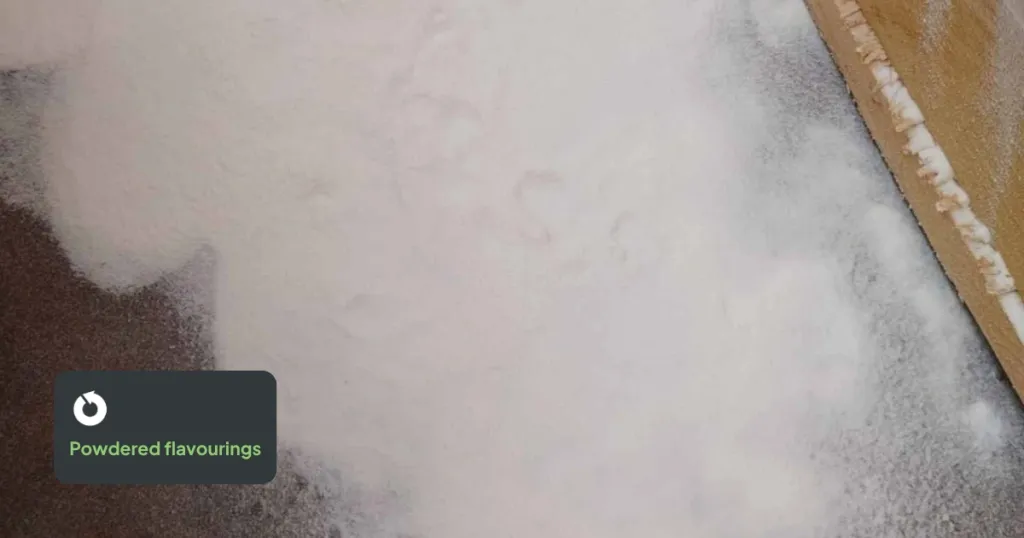
Powdered flavourings are ingredients used in the food industry to impart or intensify taste and aroma across a wide range of finished products: snacks, baked goods, ready meals, seasonings and powdered beverages.
They are produced from liquid flavourings or extracts of natural or synthetic origin, which are mixed with solid carriers and dried through spray drying: the process atomizes the liquid mixture into small droplets that solidify rapidly on contact with hot air.
The residues generated in the process are mainly of two types: the processing powder residues known as heads and tails, the fractions that form at the start and end of each production cycle and that do not meet the finished-product specifications, and the powder deposits. Both fractions of powdered flavourings have a predominantly organic composition, derived directly from the source flavourings and the carriers used in the process.
The journey of powdered food flavors scraps with Sfridoo
Following the intervention by Sfridoo, the company now has a complete set of documents that enables the compliant management of the powdered flavourings as a by-product: a technical report, a by-product data sheet, a supply contract with the buyer, a declaration of conformity, and a management template. With the new classification, the residues are by-products that can be valorised for a new supply chain and are no longer waste.
The analysis confirmed that the powdered flavourings from the production of various food products met all the requirements of the Italian Environmental Code (Legislative Decree 152/2006, also known as the “Testo Unico Ambientale”, which transposes the European Waste Framework Directive 2008/98/EC), thereby confirming their classification as a by-product.
The food powders are no longer sent for composting as waste but are now transferred as a matrix for the production of organic fertilizers, under a supply contract that regulates their transfer and ensures their traceability.
Would you like to buy or sell organic waste?

Find out how to do this in a simple, sustainable and competitive way in the section on Pre-consumer Organic,, Agri-food waste and Biowaste on Sfridoo
Find out moreBenefits for producers of food flavourings and ingredients
The first direct effect is a reversal in the economic value of the material: from a disposal cost of €275 per ton to a revenue of €25 per ton, representing a change of €300 per ton — an improvement of 109% relative to the previous disposal cost (calculation basis: 300 ÷ 275 €/ton). The disposal cost is effectively eliminated (−100%) and replaced by revenue. Based on roughly 65 tons per year, the improvement on the material line item is €19,500 per year (calculation basis: 65 tons/year × €300/ton difference between the previous cost and current revenue).
From an environmental and reporting perspective, the reclassification of the powdered flavourings removes that amount from the annual organic waste accounting. For a company that prepares a sustainability report or operates an environmental management system compliant with ISO 14001, this translates into a direct improvement in environmental performance indicators, the specific organic waste generation per unit of product, and into more favourable content for ESG reporting to customers, investors and stakeholders in the food sector.
In terms of operational governance, the new management model standardizes the traceability flows of the material deriving from the flavourings residues: clear procedures for plant personnel and a reduced risk of non-compliance in document management.
Diverting the material to the fertilizer supply chain, rather than sending it for composting as waste, positions the powdered food flavourings by-product within a higher-value-added supply chain, with positive effects on the company’s sustainability messaging to its customers in the food industry.
Would you like to reap the benefits of Industrial Symbiosis?
Discover the benefits of the Sfridoo marketplace
DISCOVER MARKETPLACE