

Coffee silverskin is the thin membrane that covers the bean during roasting and is present in significant quantities in every coffee processing plant. For a company in Bergamo (Italy) operating in this sector, the 150 tons of silverskin produced annually were treated as waste and sent for composting, at a disposal cost of €100 per ton.
Thanks to the industrial symbiosis partnership with Sfridoo, silverskin has been reclassified as a by-product under Italian and EU environmental legislation, and is now used in the production of organic fertilizers: this change in regulatory classification has transformed a disposal cost into revenue of €10 per ton (Sfridoo Case Study CS40).
| CS40 Sfridoo | Before | After | Notes and operational Details |
|---|---|---|---|
| Case Study Overview | |||
| Industry | Region | Notes | |
| Original waste produce | Processing of coffee | Bergamo (Italy) | |
| Downstream use (user) | Manufacture of fertilisers and nitrogen compounds | Verona (Italy) | |
| Before and after comparison | |||
| Assessment for classification | Waste | By-product | Preparation of technical report, by-product data sheet, supply agreement, declaration of conformity, management plan. |
| Material fate | Composting | Component for Fertilizers | |
| Quantity | 150 tons per year | 150 tons per year | |
| Storage | Single Roll-off Container | Twin Roll-off Containers | Optimizing load capacity and reducing transport trips |
| Costs | -100 € per ton | +10 € per ton | From disposal costs to revenue |
| Technological intervention |
□ Yes ☑ No |
||
| Waste properties |
|
||
Coffee silverskin as waste: costs and management burdens
Coffee roasting generates a fixed amount of silverskin every day. On an annual basis, for the company based in Bergamo, Italy, these 150 tons of material represented a recurring cost: €100 per ton for composting, amounting to €15,000 in direct expenses per year. Added to this were the administrative obligations associated with waste regulations, such as maintaining records of incoming and outgoing materials, filling out identification forms for each transport, and obtaining the necessary authorizations.
The paradox was clear: silverskin is neither a hazardous nor a contaminated material. It is produced in a predictable and continuous manner through a well-defined process, has consistent analytical characteristics, and has an established disposal chain. Despite this, silverskin was treated in accordance with all the regulations applicable to waste, with direct implications for operating costs and the company’s environmental accounting.
What is silverskin and how does it form during the coffee roasting process
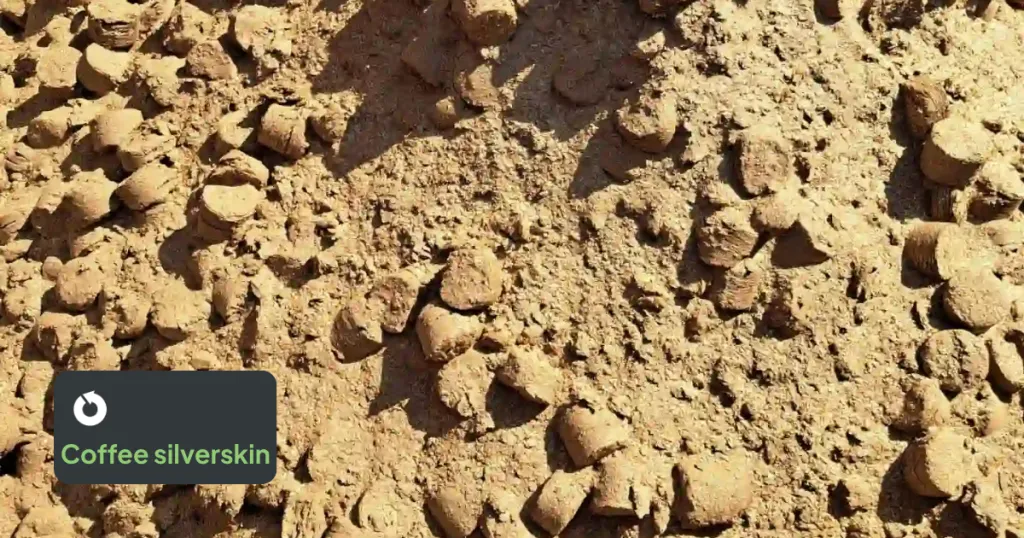
The silverskin is the thin natural layer that envelops the raw coffee bean. It has a light color, a delicate texture, and a highly volatile structure.
During coffee roasting, the rise in temperature causes the bean to expand gradually: the silverskin dries out, lifts, and peels off in the form of small flakes, separating naturally from the bean without any additional mechanical intervention.
From a compositional standpoint, silverskin is rich in insoluble fibers—particularly cellulose and hemicellulose—and contains traces of bioactive compounds, including polyphenols and caffeine in low concentrations. Analyses of this specific material yield a consistent profile: moisture at 7.1%, ash at 6.7%, and organic carbon at 48.2%.
Given its extremely light and volatile nature, the storage and transport of silverskin may require specific precautions: the material can be compacted into pressed discs to reduce its volume.
The process of enhancing silverskin
Following Sfridoo’s intervention, the company now has a complete set of documents that enables it to manage silverskin as a by-product: a technical report, a by-product data sheet, a supply contract with the buyer, a declaration of conformity, and a management template.
The analysis confirmed that the silverskin produced by the coffee processing plant met all the requirements of the Italian 152/06 Legislative Decree – also known as “Testo Unico Ambientale – referring to European Waste Framework Directive 2008/98/EC, thereby establishing the classification of silverskin as a by-product.
Silverskin is no longer sent for composting as waste but is now utilized as a raw material for the production of organic fertilizers, with a supply contract that regulates its transfer and ensures its traceability.
Would you like to buy or sell organic waste?

Find out how to do this in a simple, sustainable and competitive way in the section on Pre-consumer Organic,, Agri-food waste and Biowaste on Sfridoo
Find out moreThe benefits of silverskin as a by-product
The first direct effect is a reversal in the economic value of the material: from a disposal cost of €100 per ton to a revenue of €10 per ton, representing a change of €110 per ton. Based on 150 tons per year, the economic differential is €16,500 per year (calculation basis: 150 tons/year × €110/ton difference between the previous cost and current revenue).
From an environmental and reporting perspective, the reclassification of silverskin removes that amount from the annual organic waste reporting. For a company certified to ISO 14001 or engaged in preparing a sustainability report, this translates into a direct improvement in environmental performance indicators – specifically, the specific waste generation per unit of processed coffee – and more favorable content for ESG reporting and stakeholder communication.
In terms of operational governance, the new management model standardizes material traceability flows: clearer procedures for plant personnel and a lower risk of non-compliance in document management. The optimization of silverskin residue storage using double containers implemented by Sfridoo has also allowed for an increase in the quantity transported per trip, resulting in fewer shipments and a corresponding reduction in transportation costs.
Finally, diverting silverskin to the organic fertilizer supply chain rather than sending it to biogas production as waste, positions this by-product within a higher-value-added supply chain, which also has a positive impact on sustainability messaging to customers and business partners.
Would you like to reap the benefits of Industrial Symbiosis?
Discover the benefits of the Sfridoo marketplace
DISCOVER MARKETPLACE