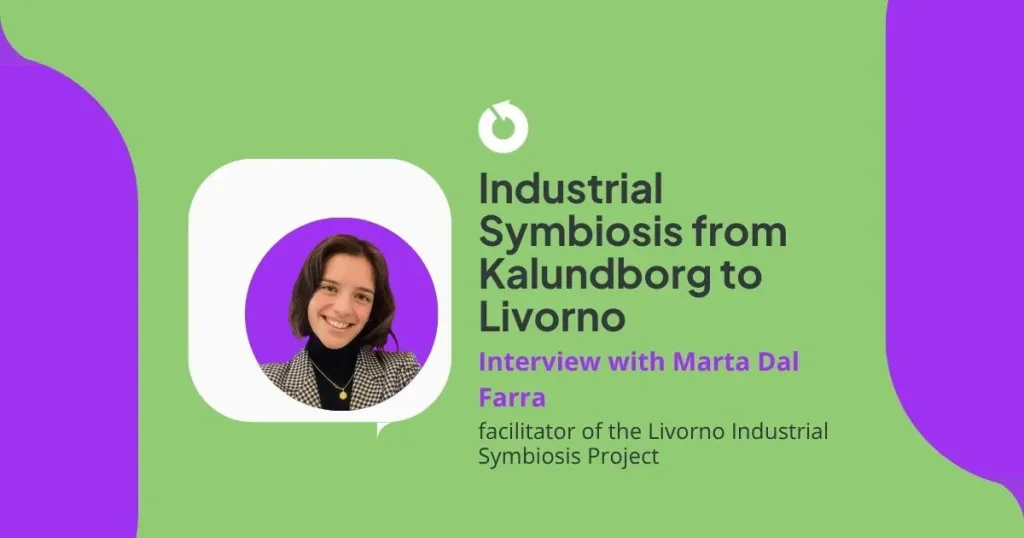
A passion has turned into a career. Marta studied Economics at the University of Verona and combined her studies with her passion for the Circular Economy right in Denmark, where she specialised with a Master’s degree in Global Development.
She describes herself as a “realistic dreamer” and believes that companies can be the driving force behind systemic change towards sustainability. With her newsletter “Marta’s Symbiosis Bubble”, she helps break down the barriers to Industrial Symbiosis, building a more sustainable future step by step.
We had a lovely chat with Marta, discussing her educational background, her experience in Kalundborg and her role as a facilitator in the Livorno Industrial Symbiosis Project, promoted by the Industrial Symbiosis Group with the support of Livorno City Council, Confindustria Tuscan Centre and Coast, and ASA (Environmental Services Company).
Marta, how did you start working in Industrial Symbiosis?
It all started out of passion. Whilst studying in Verona, I realised that no one ever talked about an alternative to the classic linear model: profit, growth, unlimited resources. I began to wonder if there wasn’t a fundamental problem, and that’s how my undergraduate thesis on the Circular Economy took shape, where I first came across the concept of Industrial Symbiosis.
Then I moved to Copenhagen and, by chance, a friend told me that her mother worked in Kalundborg Symbiosis. I went there with my backpack to introduce myself. At first they told me, “Thank you, you’re very enthusiastic, but we don’t need anyone”. A few months later they contacted me and from there I started working as a student assistant in the facilitation team. That was the start of everything.
Bring the benefits of Industrial Symbiosis into your company

With Sfridoo® you reap the residual value of your waste, reaping economic, fiscal and environmental benefits, thanks to the principles of the Circular Economy and collaboration with other companies in the network.
GET BENEFITSWhat did your experience in Kalundborg teach you?
The most surprising thing was seeing just how much of an impact a small team of five or six facilitators can have. Kalundborg isn’t just an academic case study: it’s a living ecosystem where materials, energy and water are exchanged at a local level, whilst at the same time the team manages international consultancy projects, from Africa to Brazil.
Working there gave me the chance to understand in a practical way what a facilitator does, and more importantly, it made me think: “If it works here, why can’t it work elsewhere?”
Kalundborg, however, is not all sunshine and roses. There are very large companies, such as Novo Nordisk, which are expanding at an impressive rate, and this can create an imbalance of power within the ecosystem. If a company funds a large part of the infrastructure, at some point it might say: “This is my industrial park”. These dynamics need to be monitored carefully.
Which aspects of Kalundborg can be replicated elsewhere?
It is entirely replicable, as long as there are people willing to commit themselves and do the hard work. Whenever we talk about the circular economy, we must value something that is not generally considered valuable, such as waste and discards, and this requires finding connections, building synergies, and putting lots of small pieces together.
The main idea is simple: every industrial park, every industrial zone should, to some extent, explore the possibility of sharing resources. Perhaps in a particular context, only water can be shared because the companies are close by, or perhaps only surplus heat. The important thing is to ask the question and investigate whether it is possible. Of course, achieving the scale of Kalundborg from an academic perspective is another matter entirely. They were pioneers, attracting research that gave them visibility. But there are other examples around the world doing similar things that are less well known.
How did the Industrial Symbiosis Project in Livorno get started?
It was quite an unusual way. I was working in Kalundborg when two Italian engineers from Livorno came to visit. I gave them the presentation in English, as usual, but then I realised they were italian and we switched to italian. We started talking about the good and the challenging aspects of Kalundborg. In the end, they said to me: “You’re too passionate not to try and set up a similar project in Italy”.
From there, in no time at all, with a very small team, we began studying the companies in Livorno’s industrial hub. We started without any external support: we went door to door, explaining what Industrial Symbiosis is, to evaluate whether there was any interest.
The turning point came when we were invited to the Biennale del Mare in Livorno. We had also invited someone from Kalundborg to provide first-hand testimony. Confindustria was there, they liked the project very much, and this led to an agreement to fund three years of research and data collection. We are now in the data collection phase, with NDAs signed and companies showing great interest. The aim is to move from the research phase to securing funding to actually establish the exchanges we are identifying.
A complete Industrial Symbiosis Guide
If you want to understand clearly whether and how Industrial Symbiosis can be applied to your business, this is the right place to start.
READ NOWHow does the Livorno Project differ from the Danish model?
In Kalundborg, the facilitator plays a supporting role: they collect data and coordinate, but the companies themselves decide largely independently which partnerships to form and which investments to make. The innovation we are bringing to Livorno Project is a different approach: we facilitators are the central point of coordination. We collect data, connect companies, encourage dialogue, and keep the process on track.
This is important because company employees have a thousand things to do. If there’s no one to keep things on course, the flow gets lost. One of the biggest challenges in these projects is precisely the timing: moving from “yes, I like the idea of symbiosis” to collecting data, analysing it, setting priorities, and then dealing with the real complexities, such as the chemical compatibility of a by-product, regulations, and logistics. That is where the real world of symbiosis opens up, requiring time, research, and many people around the same table.
Also, we don’t just stop at data mapping. We build international networks, take part in european bids, and make connections with other facilitators. Simply taking part in the project has already brought real benefits: one company told us it won a european bid just by stating it was part of an industrial symbiosis project.
What does an industrial symbiosis facilitator specifically do?
The role of a facilitator is a real juggling act, in the best sense of the words. From the outside, it looks like it’s all about data mapping and facilitating. In reality, it involves managing people, organising calls and meetings whilst ensuring no one feels left out, building trust with companies, promoting the project, applying for funding, and international networking.
The key is to be people who are motivated to find solutions. It is necessary to be empathetic, to know how to build trust, and to make companies understand that you have both the expertise and the motivation to do the job.
Then it takes technical skills and plenty of connections: in politics, industry associations, and companies. Bringing together organisations that would not normally interact, and maintaining a balance between all these parties, is no easy task.
My hope is that the role of symbiosis facilitator will be recognised at an institutional level, that dedicated study programmes will be established, and that it will become a common job role. For now, this is a small world that has yet to blossom.
In your opinion, what are the main obstacles to the growth of Industrial Symbiosis?
My master’s thesis addressed precisely this question, and the answer is that the greatest challenge is knowledge sharing. It is often discussed in academic terms, whereas the core concept is simple: to communicate and try to exchange resources that would otherwise go to waste.
Companies often don’t even know what Industrial Symbiosis is. And when they do find out, they sometimes struggle to believe that sustainability and economic benefit can go hand in hand. Yet companies today need to save money, have resources close at hand, and simplify their production processes. Environmental regulations are becoming increasingly stricter, raw materials are getting more expensive, and waste management is becoming more costly. Industrial Symbiosis brings many pieces together: it is complex, it is difficult, but when it works, the impacts are tangible and measurable.
My hope is that, at european level, we will begin to invest in a systematic way in Industrial Symbiosis. But in the meantime, from the bottom up, companies like Sfridoo, and projects like ours in Livorno are proving that it is possible. Industrial Symbiosis should be the standard, not the exception. Why continue to waste resources when the solution is to collaborate?
Buy and Sell Industrial Waste

Sfridoo Marketplace helps your company find new partners to maximise the value of your waste, by-products, secondary materials and company stock leftovers.

Caterina Bonafede
Sfridoo Staff
Turn your waste into value